
I stumbled across this place a few years ago when I was driving past and didn’t have a camera with me, and it’s taken me a long time to go back to take a closer look. It’s an impressive place and, well the Historic England listing describes it better than I ever could:
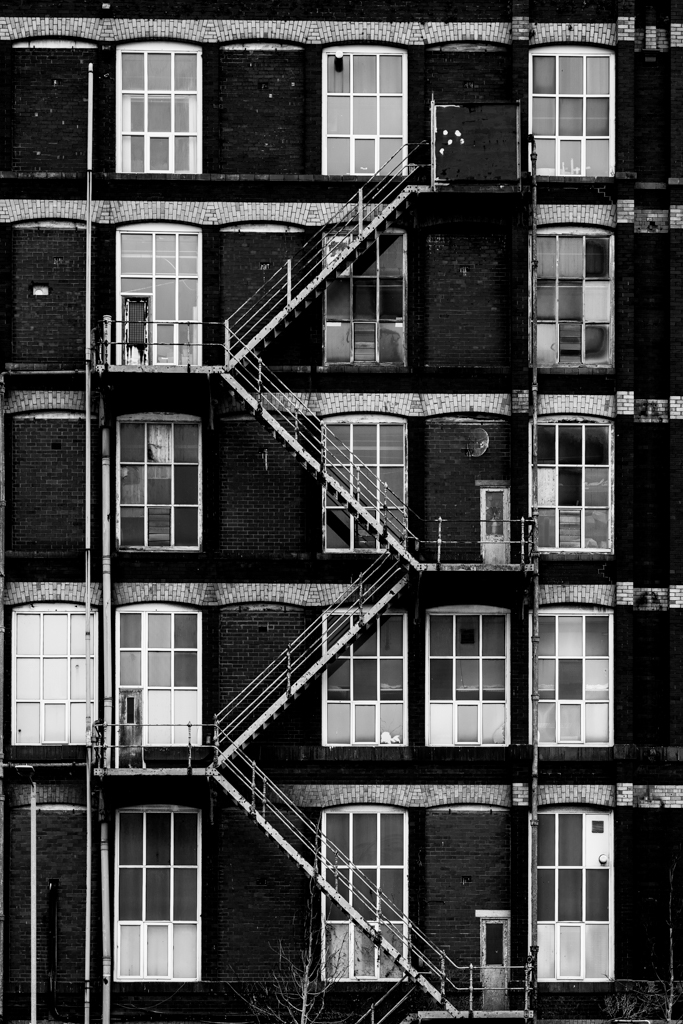
“Cotton spinning mill. 1905 by Stott and Sons of Oldham. Concrete and steel framed with red brick and terracotta facing. Flat roof not visible from ground. Six storey rectangular block with corner stair tower and projecting hoist tower in centre of one side. The lower three storeys are of continuous glazing, large 9-light windows separated only by narrow brick piers and the expressed concrete slab at each floor level. These floors are for the carding machines. The upper three floors have alternate windows and brick panels. These are the spinning floors. The stair tower has arts and crafts detail with clasping buttresses in the centre of each side. The concrete floor bands go round the tower and there are further terracotta bands. Staggered stair windows. The tower is topped by a scalloped terracotta parapet and a copper dome with finial. The hoist tower is one window and one brick panel wide all the way up and is capped by the word ‘BUTTS’ in white tiling. This mill was designed as a double mill and has one wall unfinished. The mirror half of the mill was never built. It is the only large, early C.20 cotton spinning mill in the Wigan district and one of the best surviving examples of its type in the Greater Manchester area.”
OK, so that’s a rather factual, objective description, but it’s certainly an impressive place, and with it’s (reduced in height) chimney, quite intact. As the description says, the mill was designed as a double mill but never completed as such and the result is that the wall on the west elevation (the left of the picture above) where the other unbuilt mill would have joined is just a plain, unfenestrated wall. I can’t find any reference as to why it was never completed, but I suspect the the up and down nature of the 20th Century textile trade meant there was never a need for expansion. It would certainly have been an enormous building if it had been completed.
 Mechanical Landscapes