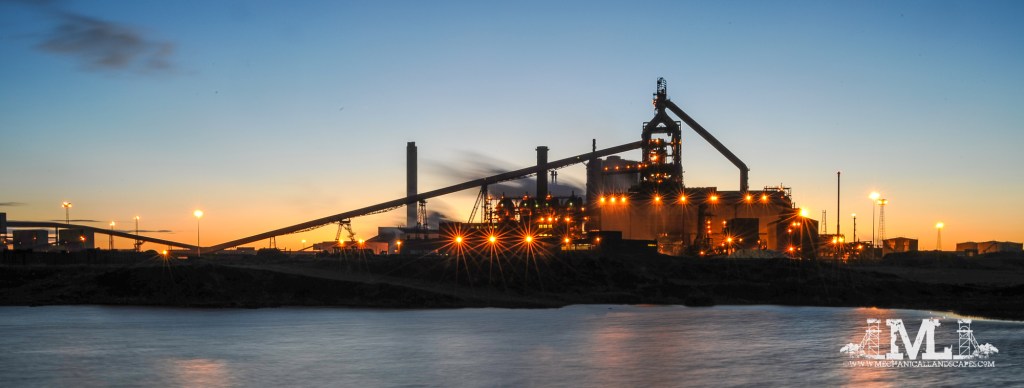
Recently, I’ve been going through the photographs I’ve taken of the Redcar steelworks on my various visits over a 10 year period before it was demolished, and I found a series of night photographs that I’d forgotten about.
I’ve actually posted a couple of them before (a good few years ago), but it’s always good to look again at old images with a new pair of eyes and an improved skill set / toolset.
I took some handheld with a high ISO and some with a tripod. Well, I say high ISO – ISO6400 on my Nikon D700 wasn’t the highest it would go (it could do 12800 but you wouldn’t want to), but for the time it was regarded as excellent and very usable. Nowadays, my mirrorless Nikon’s have much better noise control at similar ISO’s although they don’t go as high as my old Nikon D4 which was faintly ridiculous but weighed about three times as much as my Z7ii. And I value compactness over extreme low light performance these days, as Lightroom Denoise is extremely effective.
But I digress – it’s the tripod mounted long exposure images that caught my eye. I’d dismissed them in my original post for making the water look weird, and to an extent I still think that. but only because of the colour and amount of the frame it occupies. It becomes a bit dominant and something of a distraction.
I’ve always liked panoramas and realised that this might be a good contender for a severe crop. I don’t have a specific ratio that I work to, I just crop it until it looks about right. That said, I did a 3:1 ratio for this as I was posting it on Instagram and that works well on that platform.
The crop also cuts out a swathe of the water and adds a little balance to the blue sky, although it could maybe do with a hint of blue adding to the water as it’s more of a steel grey but the orange reflections do break the expanse of greyness.
 Mechanical Landscapes