I took a wander round the Middleport area as I wanted to photograph the bottle kilns at Furlong Mills (not the easiest things to photograph and they’re not very interesting photos), but a tall brick chimney nearby piqued my interest. Turns out it was the Middleport pottery, which I didn’t have the time to go in and look round, but as I continued to wander I noticed some ruinous buildings down the road so naturally went for a look.
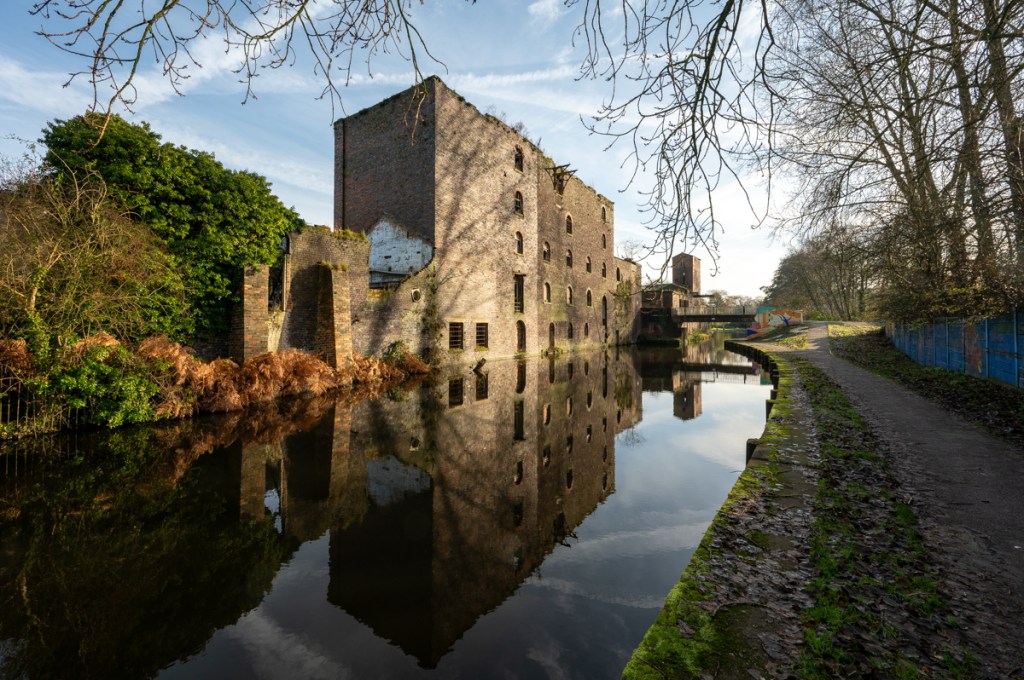
The first mill like building was set back from the road beyond a yard surrounded by a large wall, but a side road led to a canal bridge which gave clear views of this and the adjacent calcining mill.

It took a bit of googling but I found this page which explains that it is a flour mill and was built in 1844. It remained in use for that purpose until 1924 after which it was used as a bakery and after that a fireplace company used some of it. I don’t know how long it’s been derelict for but the complete absence of a roof – and I suspect the gables – would suggest it’s been derelict for a long time.

I found this side view simultaneously boring and interesting. It’s just a plain façade but it appears that the building has been extended to the left at least once and maybe twice. The windows on the far left are topped by a simple lintel rather than an arch of bricks, while the size and placement of them in the rest of the building is seemingly haphazard (presumably due to the internal layout and machinery placement).
Visually I was struck by the shadows cast by the trees behind me. This was a morning in late November and the sun was low in the sky but I was still surprised at how big the shadows were.
Adjacent to the flour mill is the Middleport calcining works which is in a similar state of decay. The article linked above also covers that place, and it covers the process of calcining which was something I wasn’t aware of (although ceramics isn’t something I’m well up on).

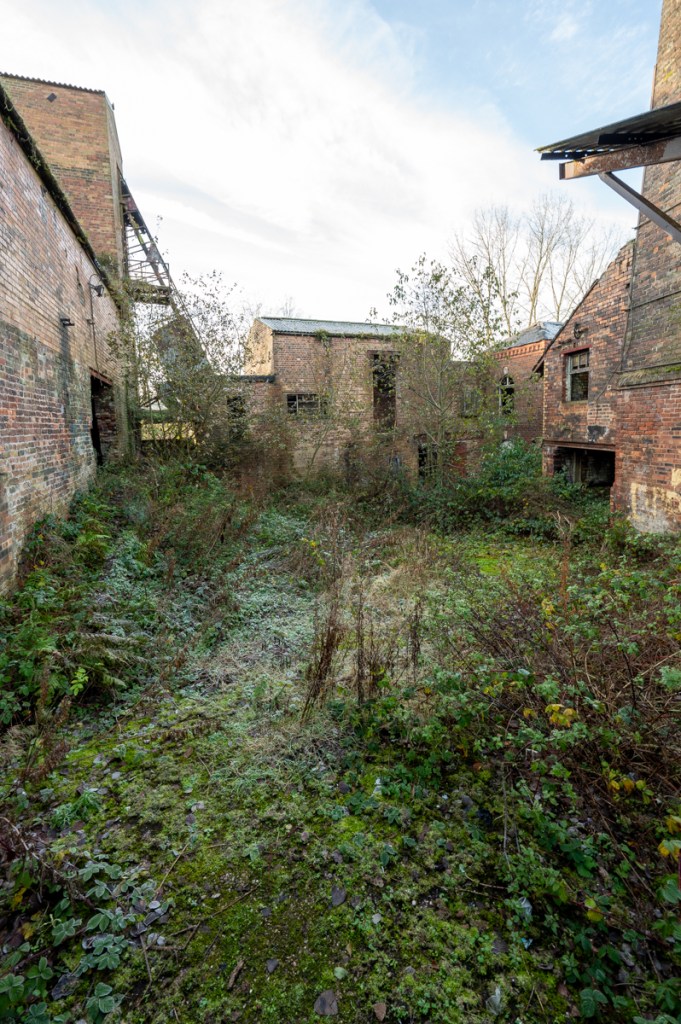

Calcining is effectively the process used to burn flints thus softening them to make them friable so they could be more easily crushed and ground for use in the pottery body recipe. The kiln
fired the materials to over 1000 C and had two chambers sharing one chimney.
The mill was operated by Goodwins Mill Co and I can’t find any definitive history, but the Historic England listing describes it as being a mix of early 19th century and 20th century structures. I’ve not found a definitive closure date, but the same site suggests that the clean air act of 1964 hastened the demise of coal fired ovens in the area, and this picture on Flickr says it shut sometime in the 1960’s so there you go.!
 Mechanical Landscapes
some more lovely reflections!
—🙞🙟🙥🙤☙❀❁❦❁❀❧🙦🙧🙝🙜—
LikeLiked by 1 person
Thanks Graham! I think the reflections came out really well here, the light was just right! 😊
LikeLiked by 1 person
and presumably it was a nice still day! lovely outcome 👌👍🌟✨💫
LikeLike