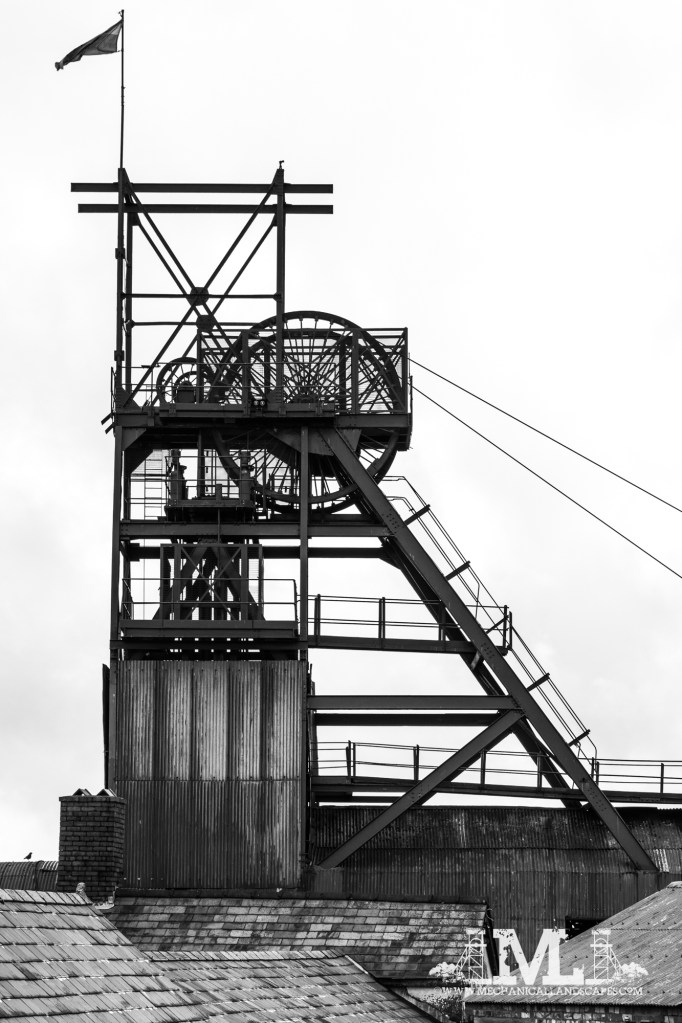
Big Pit was my last port of call as it was the most easterly pit and therefore – technically – on the way home. It’s the home of the Welsh Mining Museum so like all museums is free to enter, but they do charge £5 to park so regard that as an entry fee of sorts. It’s not the biggest of pits, with only one smallish headgear, but it’s more or less all there. I suppose that’s the problem with preserving a large pit – there’s just too much to preserve and maintain, witness to that would be the sorry state of Chatterley Whitfield, which although once a mining museum has been shut for 30 or so years and is arguably in a state of irreversible decline due to the enormous cost of restoring it. So, it seems to be that a small pit*, like Caphouse Colliery which is now the English National Mining Museum, is easier and cheaper (relatively speaking) to run than a very large pit and like Caphouse, you can also go underground at Big Pit. As in properly underground, down the 300ft shaft in the cage to be given a tour by an ex miner of some of the tunnels. Although it’s no longer extracting coal it’s still classified as a coal mine by the Coal Authority and has to operate like one. Hence, there are restrictions on what can but taken down (nothing with batteries in, so no cameras, watches, car keys, etc) and the mine is still monitored for gas. Indeed, the mine was – apparently – shut for a day before the week previous due to a change in weather resulting since a drop in air pressure, which created unfavourable conditions underground.
This was a good way to end my whistle stop tour of the south of Wales as it allowed me to see the now unseen side of coal mining after having seen the remaining topside structures at Penallta, Cefn Coed, Tower, Great Western and Lewis Merthyr. It was also interesting to hear the stories of Iain, the retired miner who took us on the tour. I do wonder what will happen when the last generation of miners passes. Partly because of the loss of experience of mine operation, but also the anecdotes and history. And at some point will there be a loss of connection with the areas history? To many people, coal and mining is almost an abstract concept now, with just a handful of headgear dotted round the Valleys. I’m sure that many people will have living relatives who can recollect living and working the mining communities but for how long? Will passions about the miners strike be passed down? I don’t know about South Wales but when I worked in Burnley in the late 1990’s there were still people who were from ‘scab families’ and the last pits round there had shut in the early 80’s.
I didn’t have chance to see much more after the tour as I had a three and a half hour drive north ahead of me, but I’d definitely recommend a visit there if you’re in the area.
*Big Pit is named as such, not for the relative size of the site, due to the diameter of the shaft that was considered big at the time – it’s elliptical and the first shaft in Wales large enough to allow two tramways.
 Mechanical Landscapes