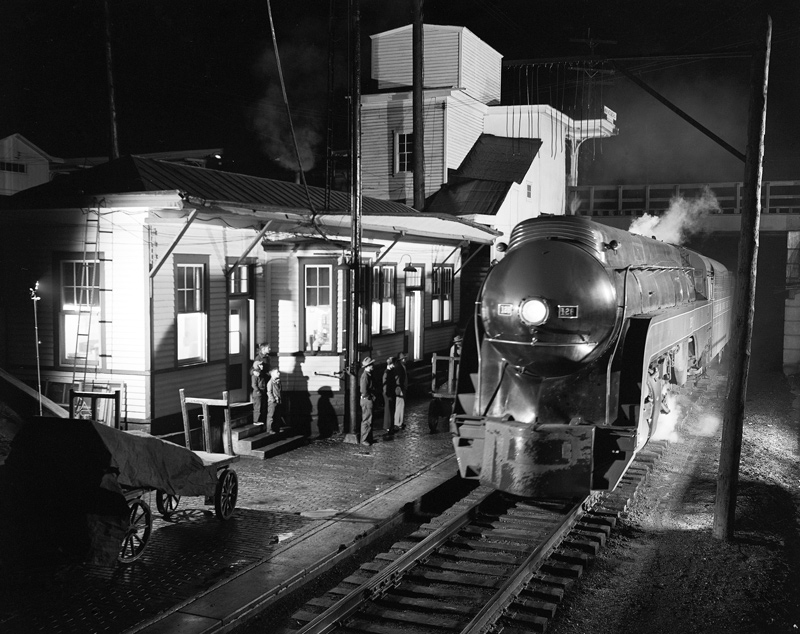
O.Winston Link – Train No.2 arrives at the Waynesboro Station, Waynesboro, Virginia
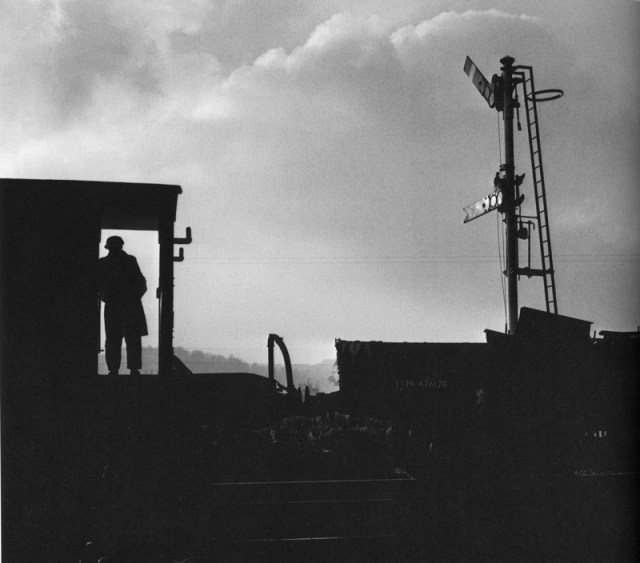
Colin Gifford
The increasing affordability of photography in the 50’s and 60’s meant that the end of steam traction in Europe and America was well documented. Two recent book releases by acknowledged masters of the genre present a fascinating contrast of styles and cultures.
Each a Glimpse is a re-release of Colin Giffords 1970 classic. Gifford was one of the pre-eminent British ‘progressive’ railway photographers of the 1960’s, and this book is more than a re-print, it’s more of a digital re-master of a classic album, with some photographs replaced with previously unseen ones.
Life Along The Lines is a new book of photographs by O.Winston Link, and apparently ‘replaces’ the two other books of Link’s photographs, of which more later. Link’s photographs were taken slightly earlier than Giffords, and documented the final five years of steam on the Norfolk and Western (N&W) Railway in Virginia, USA, between 1955 and 1960.
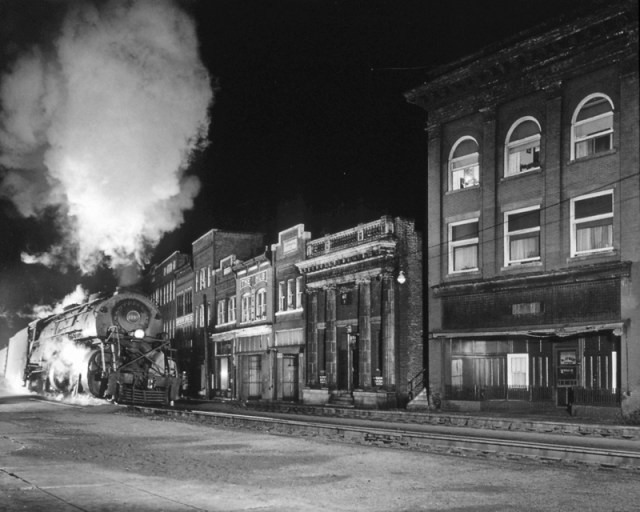
O.Winston Link – Main Line on Main Street, North Fork, West Virginia
In the preface to ‘The Last Steam Railroad in America’, Thomas Garver contrasts Links style and methods to that of the era;
“While Robert Frank and legions of other photographers walking the streets of America photographed the country as they found it, Winston link photographed America as he wished it to forever remain. Yet his are not elegiac pictures. Link created a record of the culture and life lived along the steam railroad as though it would never die. In his photos it has not.”
Link predominantly used 4×5 large format field cameras, shooting mainly (but not exclusively) black and white. He is perhaps best known for his spectacular, often heavily staged, night time photographs along the N&W network, and these took in not just the trains in isolation, but included the workers, passengers and the people who lived along the line. Memorable photographs were taken at a drive in cinema, in a lineside living room, overlooking teenagers swimming in a moonlit river, all of which the train played a bit part role in the composition.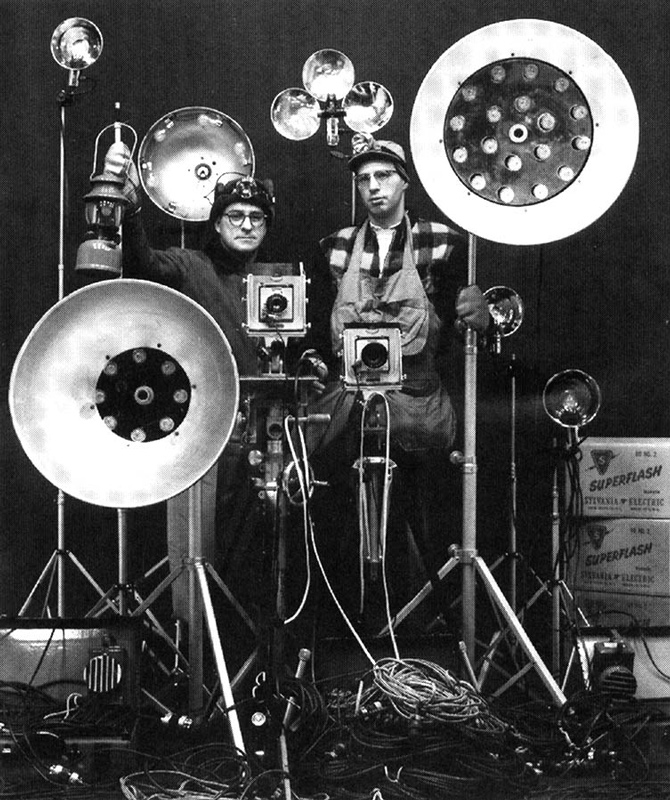
The photographs are masterpieces, and are widely admired beyond the railway community. But Link was more than a railway enthusiast with a camera. He was a successful freelance commercial photographer, and the project to document the last years of steam on the N&W was a huge one that fitted in around his work. He had the benefit of the official backing of the railway (although it was very much a personal project, and not a commission) which doubtless made the creation of the photographs easier, and they often involved huge, and hugely elaborate lighting setups for the night photographs. Such was the scale and complexity of these, few have come anywhere near to matching the results (although Andrew Rapazcz in the UK and Olaf Haensch in his book NachtZuge have adopted a similar, albeit smaller approach). And yet, there is far more to Link’s work than just black and white night photography. There was a lot of daylight photographs taken, including a number in colour (although he only took two in colour at night – remember he was using large format film, which is in individual sheets rather than rolls), and these are unstaged. However, they are all meticulously taken and composed as Link would drive to pre-determined spots in his car, set up his cameras, make the photographs, and then if possible, drive to another spot to get another photograph or two. His daily output on large format could be in single figures if he was out in the countryside chasing trains. And yet, as this was a personal project, relatively little of his years of work was published at the time, and it was not until 1978 that a proper exhibition of his work was held, and finally in 1987 Steam Steel and Stars was published. This was an album of his night photographs and this shot him to fame. This was followed by the aforementioned The Last Steam Railroad in America in 1995, and Life Along The Line in 2012.

O.Winston Link – Roanoke Shops
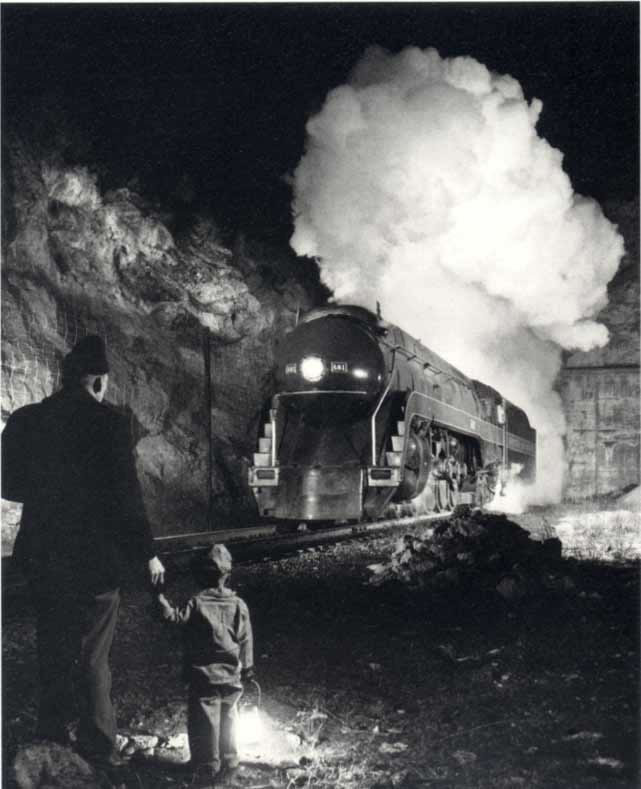
O.Winston Link – Father and son at Montgomery Tunnel near Christiansburg, Virginia
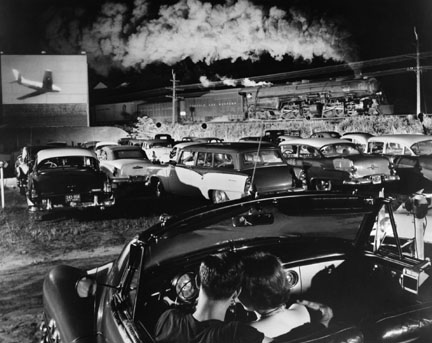
O.Winston Link – Hotshot Eastbound, Iaeger, West Virginia

O.Winston Link – Hester Fringer’s Living Room On The Tracks, Lithia, Virginia
After flicking through a book of Link’s work, the contrast in style with Gifford is startling, but of course, the photographers were working in different countries and in different circumstances, to different agendas. And of course they weren’t the only people out there taking photographs – notable contemporaries in America include Richard Steinheimer and Jim Shaughnessy, and David Plowden, while in Europe there was Ian Krause, John Hunt, Paul Riley, Colin Walker, Les Nixon and others. The European style is more reminiscent of that described above as Robert Frank’s – photographing things as they were. What made Giffords work stand out though, was that it was different to the traditional railway photographs in the magazines of the times. Three quarter ‘wedge’ shots and the like had been the typical railway photograph for years, but here was someone who while not shunning front three quarter views entirely, made them just one part of the composition. The breadth of Giffords work is considerable – unlike Link who completed 20 trips over 5 years documenting the N & W, his three key books (Decline Of Steam, Each a Glimpse, And Gone Forever) cover virtually all of the British Rail network, from the south Coast and Cornwall, all the way up to Scotland. Once the N & W project was complete, Link took no more railway photographs.
While Link had some of his images published in contemporary magazines, he was not widely known, possibly because, as described in Life Along The Line, he was rather difficult to deal with in getting his photos for publication.
By contrast, Gifford was widely published in magazines of the day, and his first book the 1965 ‘Decline Of Steam’ was a revelation to many young steam photographers. This approach became known as the ‘New Approach’, and while there appeared to be no one single initiator of the new style, many look to Gifford as being one of the most influential. Ian Krause, one of the better protaganists of the New Approach was beginning to develop his own style when, as he wrote in his brilliant book with John Hunt On and Off The Beaten Track:
“There are times in life when you really believe that you’ve discovered something other than a cliché. This was the time: within a month it was a cliché. Colin Gifford’s Decline of Steam had made it so. Whilst on the one hand he had broken the stranglehold of the old guard who had monopolised the photographic content of railway publications since the 1890’s, he had also blown the new horizons that a few of us had begun to see clean off the edge of the earth. It took a few months to recover, but we now had a standard to work to, and there was a new sense of creativity emerging, not just in photography, but in the whole field of the arts as well”
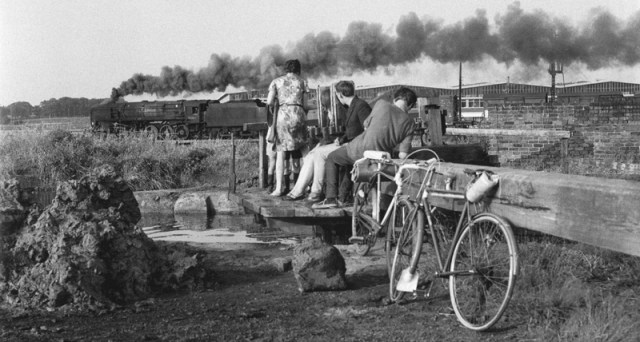
Colin Gifford – 92166 runs beside the St.Helens Canal at Winwick Quay with a northbound freight
While there’s enough to write a whole article on the ‘New Approach’, it was best summed up by Ian Krause as ‘….a hybrid of pictorialism and photo-journalism.’ To that end, as described above, the approach while no doubt well planned, was far more informal than Links, in a more ‘candid’ style, that took in not just the engine and train, but the urban and rural landscapes that the railway was a part of. The name ‘Each a Glimpse’ is actually taken from a line of Robert Louis Stephenson poem ‘From a Railway Carriage’ which is actually about the fleeting sights seen when travelling on a train, but is actually an appropriate description of some of the images in the book. In some, the train is but a tiny part of the whole composition, a fleeting part of the landscape distinguishable only by a silhouette or a trail of white steam, very much as you would see as if you were walking down a road or a path in that era. It lacks the precision of Links work, maybe because of the smaller format it was taken on giving less definition, but it feels very gritty and British, very much of its era. It’s like Get Carter and other British dramas of the time. And yet Gifford work is incredibly creative in a different way. While Link sculpted light and arranged engines. Giffords pallete was different. He worked with what he saw in front of him to realise his own vision. His was not an untrained eye – he attended art school and was himself influenced in his railway photography by Jean-Michel Hartmann’s book Magie du Rail.
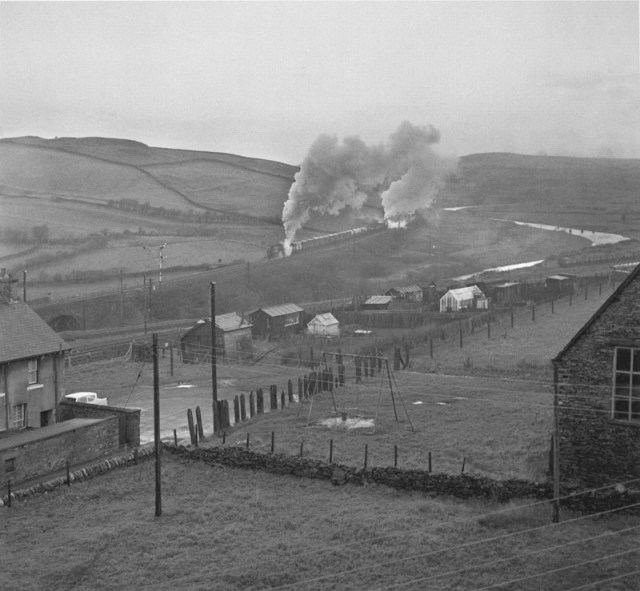
Colin Gifford – a class 5MT leaves Tebay with a northbound freight
Neither photographer was without his critics – the ‘New Approach’ had been derided as “….an out of focus blur passing some grainy cooling towers….”, while Wikipedia quotes Gifford as describing Link’s work as ‘too contrived’ and ‘pantomime’.
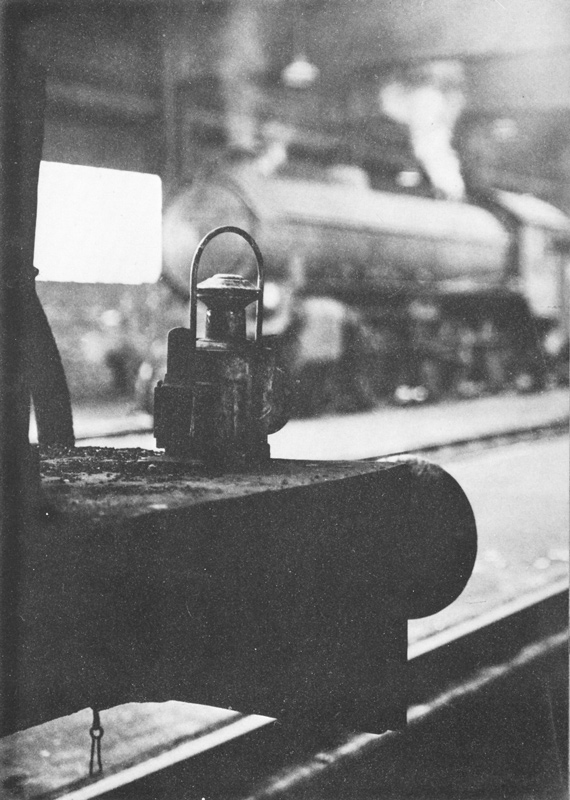
Colin Gifford – Bathgate
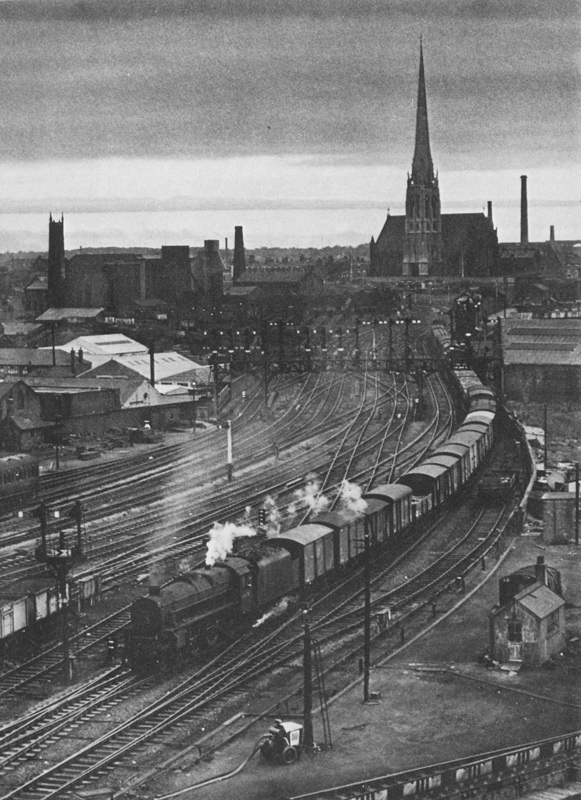
Colin Gifford -Morning Freight At Preston
It is worth touching on the subject matter itself as well, as after all these books are about railways. We’re blessed in the UK to have an abundance of heritage railways with an abundance of engines like Austerities and Black 5’s, so seeing these in action (and not on charters), in some quite familiar locations is quite fascinating. But then when you see the enormous 2-8-8-4 American locomotives double heading mile long coal trains, Links photographs might as well be of UFO’s landing at Roswell. It’d be interesting to get an American view of the British engines, seemingly related to the American behemoths only in the principles of steam propulsion. But one thing that both photographers do have in common is there inclusion of people in the photographs, as well as the surrounding landscape. Giffords recording of the British urban landscapes of the 60’s is very much of that era – foggy, grainy, Lowry-esque, remisniscent of some of the work done by the likes of John Bulmer and Don McCullin in the north of England. His style was often to have the train just as one part of the composition, sometimes only a tiny part of it. By contrast, Links style had the train as the obvious focal point, but in varying degrees of visual importance. However, Along The Lines contains a lot more of Links photographs of people of the railway, and some with no trains at all. Interestingly, in Links letter to the railway asking for their co-operation in the project, he did state that he would like to include an employee in every photograph (a worthy aspiration that didn’t ultimately happen, but there is a heck of a lot of human interest in the body of work). As a consequence, of all of the books of Links photographs, this is by far the most definitive, rounded record of the railway.
While Links work is unique and unlike any other railway photographs before or since, it has to be viewed in that context. Other American photographers were taking photographs that were more candid in their approach, although the ‘New Approach’ probably didn’t make it over the Atlantic because American steam had all but disappeared by 1960, a time when the New Approach had yet to evolve. And while I wasn’t around at the time, this was well before the internet age, and I can’t imagine there being too much transatlantic sharing of images. But viewing the two side by side is like comparing Dallas with Coronation Street. Links work can be almost cinematic in its style and attention to detail, while Giffords is more of a 1960’s Kitchen Sink drama – gritty, urban, real. Both were masters of their approach, and railway photography is a better place for it.
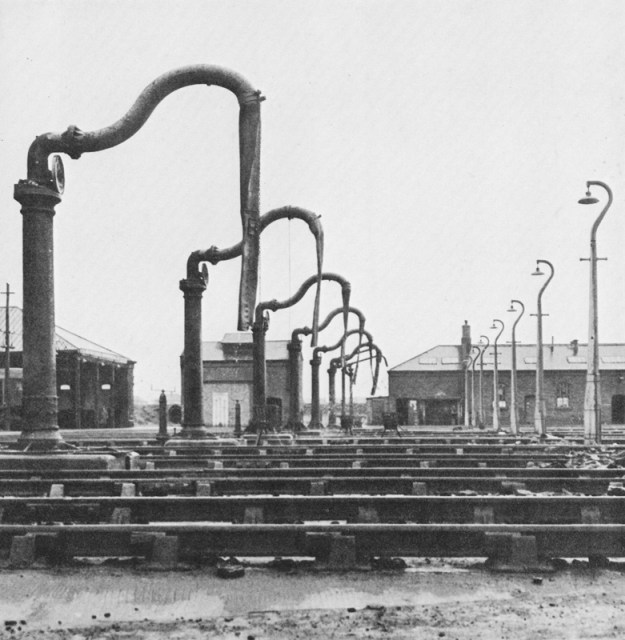
Colin Gifford – Trafford Park
Order the books at Amazon:Each a Glimpse…
and
O. Winston Link: Life Along the Line: A Photographic Portrait of America’s Last Great Steam Railroad


 Mechanical Landscapes
Interesting stuff. Wonderful to see a main line on a main street!
LikeLike
Yes it’s a bit of a step up from the Welsh Highland Railway running through the streets of Porthmadog isn’t it!
LikeLike
Gifford ..”was himself influenced in his railway photography by Jean-Michel Hartmann’s book Magie du Rail”
Actually No, Wikipedia is sady wrong on several things about CTG. He didn’t see JMH’s masterpeice until after the publication of ‘Decline’ !
LikeLike
Thank you for this, I’ll take your word for that as I’ve little other information than from books and wikipedia. If you can correct anything else or provide any additional information, I’d be pleased to include it in the blog post.
LikeLike
Wikipedia claims that Ian Krause ‘ introduced the “New Approach” at Ian Allan, not CTG’. Ian has confirmed to me only today that this is indeed incorrect, and also that although CTG went to Harrow Art School, Ian certainly did not!
Wiki also implies that CTG spent more time in the company of the the MNA than was actually the cases.
It is interesting you refer to the work of John Bulman as Colin enjoyed many of the photographs included in Bulman’s recent excellant ‘Northern Soul’ exhibition.
LikeLike
Yes, I took what I needed from wikipedia, I’m not entirely sure who wrote the entry, but it does seem to be someone who is well informed (other than the points you’ve raised).
I saw John Bulmers exhibition at the National Coal Mining museum and enjoyed it immensely. His recent book ‘The North’ is a more extensive collection of those colour images, including some black and white.
LikeLike
Andy . prompted by your excllent post a little response from me http://martincreese.blogspot.co.uk/2013/01/a-glimpse-and-2013.html#!/2013/01/a-glimpse-and-2013.html
LikeLike
Thanks for the link, and thanks for the link back to here Martin. I think you’ve articulated some of my own thoughts on the subjects really well there.
LikeLike
Sorry for the very late response, but I’ve only just discovered your very fine website. While I agree wih much of what you say, I’m inclined to disagree that the new approach never made it across the Atlantic, indeed from what I’ve seen in the US magazine ‘Classic Trains’ and the 2015 book ‘Railroad Vision’ (a weighty tome showcasing a selection of images from the ‘Trains’ magazine archive), I would suggest that a more imaginative approach was being taken their earlier than in the UK – certainly in the early 1950s, if not the late ’40s. You rightly mention Steinheimer, Shaughnessy and Plowden (incidentally there are W W Norton books featuing all three photographers which are worth seeking out), but I would add Philip Hastings, who worked very closely with the ‘Trains’ editor, David P Morgan, and who was possibly the earliest exponent in the US, and Bruce Meyer – the ‘Railroad Vision’ book gives a tantalising glimpse of his work comprising just a handful of very atmospheric shots, and I would like to see more of his output.
Whether this had any bearing on what was happening to railway photography in the UK and Europe is difficult to say, but I suspect not.
Regards,
Bill
LikeLiked by 1 person
Thanks for your comment Bill and for pointing out the work of some new photographers for me to explore. I’ll check them out and write a more considered response once I’ve looked at their work and re-read my article (it’s a few years since I wrote it!).
LikeLike
I’ve struggled to find much online of the three photographers you mention although there is some interesting work from Philip Hastings from what I can see. I’ve also had a look through a few ‘Classic Trains’ magazine that I have and I think the standard of amatuer railway photography in America was good, albeit with the inevitable preference for the front three quarter view, both static, moving and in the landscape. Don’t get me wrong, I’ve taken plenty of this type of shot myself, but it’s not the only way to do railway photography and I think it’s this desire to see something different which led me to the work of Gifford and others.
It’s interesting to see how a non-railway photographer approaches the subject. On my other blog, as well as on here, I have a number of photographs taken from the Library of Congress online archive, specifically the Office of War Information collection. These were taken in an official capacity by the government during world war 2 to record the war effort ‘at home’. The collection has beens canned en masse and put online in a pretty raw state, so I’ve done some restoration work on the files you can download and created anew blog. The work of Jack Delano is probably of most interest from a railway photography perspective, although there are others. Of course, the photographers had pretty much unlimited access, bu tht resulting body of work is very interesting
https://planesboatstrains.wordpress.com/tag/jack-delano/
Andreas Feininger’s photographs of the Bingham Canyon copper mine are also worth seeing:
https://planesboatstrains.wordpress.com/tag/bingham-copper-mine/
LikeLike
Hi Andy,
Sorry it has taken me almost two years to reply! There are some really great shots in both of these links – the two electric hauled trains with a steam light engine on the bridge and the bridges in silhouette, both at the copper mine, are absolute belters, for example.
You muse about the approach of non-railway enthusiasts to railway photography, well I’ve just come across another US name which is new to me – Aubrey Bodine. He was a professional photographer and it’s interesting to see that his railway output spans the whole spectrum from absolutely conventional wedge shots (in the Lucius Beebe tradition) to atmospheric. A book of his railway photographs has been published recently and it’s listed on the WH Smith website, so I will probably order it in due course.
https://www.aaubreybodine.com/page/default.asp?tag=BodineTrains
By the way, have you seen ‘Transition’, the new Gifford album? I was most impressed with it the day it arrived in the post, but the more I look through the less I’m convinced. Yes, the quality of the printing justifies the amount of effort which David Postle put into getting that right, and there is no lack of noteworthy shots, not least the front and back covers, but I feel that there are a number which really don’t deserve to be in there. Don’t get me wrong, I still consider it to be a notable book overall and I certainly don’t regret forking out £30 for it (in fact I would argue the price is actually too low), but when I see comments on the internet suggesting that there’s not a poor shot in it, then to me that’s just indulging in sycophancy!
Best regards,
Bill
PS This link is worth following up as well:- http://www.railphoto-art.org/about/
LikeLike
Thanks Bill, and apologies for taking a while to reply myself. I’d actually come across Aubrey Bodine’s work earlier this year as he’s did both railway and industry which you may have realised if you’ve read my blog are the two primary subjects I photograph! I spent quite a bit of time on the website which I found slightly frustrating to use.
I do have a copy of Transition, I pre-ordered it and was glad when it finally arrived. I agree entirely with your comments, and I think it would have been just as good with fewer photographs in. It does make a nice continuation of his series though (I think I have all of his books now). There are of course many photographers of that era who were as good but less well known – a favourite of mine is Anthony Brown who can be found on Flickr here https://www.flickr.com/photos/74596785@N06/. Unfortunately he’s recently removed the vast majority of his photographs from the 1960’s, and there were hundreds of high res scans from Britain and all over Europe, but it’s worth keeping an eye on his page as he’s just started putting some more up, albeit at a very small size.
LikeLike
Hi Andy,
A long gap again but having just been given a copy of “The Railroad Photography of Phil Hastings” (published 2023) for Christmas, I thought it was worthwhile leaving another comment. It’s clear from the text that his biographer Tony Reevy considers Hastings to have been in the vanguard (but not the sole practitioner) of what one might call the North American New Approach (although that term is never used as such and it’s not quite the same as the New Approach practised by Gifford etc in the UK).
I wish I could recommend the book (readily available on Amazon) but although the text is fascinating, the reproduction of photographs is all over the place – some shots are spot-on but many can only be described as dire – far too dark with completely blocked up shadows. One suspects that in an effort to cut costs, not enough time has been spent optimising the negative scans. Partly because of the poor reproduction, it’s not obvious to me that the selection of photographs represents Hastings’ best work, so interesting as the book is, I wouldn’t regard as it the definitive work on the man and his photography. Reevy has also done similar volumes on Jack Delano and Clegg/Beebe but I’m a bit loathe to risk ordering either book unseen (albeit the reviews on Amazon are much better than for the Hastings book).
Best regards, Bill
LikeLiked by 1 person
Thanks Bill, I’d not heard of the book but I have heard of Phil Hastings. I’ll definitely look up his work online but might pass on the book as like you I do value good print quality. If nothing else, the printed image in a book should do justice to the photographers original interpretation of the negative in the darkroom.
LikeLike
Andy,
Have you seen the new Gifford book “In the Wink of an Eye”? It’s 100% colour and I would be very interested to know what you think of it.
Best regards, Bill
LikeLiked by 1 person
Hi Bill, yes I bought it just before Christmas but haven’t spent much time with it yet. Thoughts so far: I think there are maybe too many photographs – I’d rather they had gone with quality over quantity. I did note that it says in the introduction that some of the films were experimental films which may account for the lower quality / degradation of some photographs . But I also understand the idea that the quality of image (scene / content) is more important than the technical quality of the image.
I do like what I’ve seen of the book, I just need to spend more time with it now that the rush of the Christmas period is over.
LikeLike
Andy, it would be wrong to say that I didn’t know what to expect when I opened the book on Christmas morning (it was a present from my wife) as I had been to Kidderminster Railway Museum in September to see a mock-up which David Postle had kindly prepared. Normally I don’t buy colour albums but I thought it was interesting enough to justify the £45 cost and, in any case, I wanted to complete my collection of CTG albums. However ‘interesting’ remains my view – there are a number of shots which work well enough in colour to qualify as outstanding, but overall I feel that it has nowhere near the impact of his black and white albums (and whether I would have bought it without the Gifford name attached is very doubtful). Personally I would much prefer to have seen a new album of previously unpublished monochrome material (or even a revamped version of Decline of Steam) but the comments on the RMWeb site clearly suggest that there was strong public demand for such an album and, judging from the introductory text, it has been a long-standing ambition of CTG/DP to produce it. At the end of the day I just prefer B&W for this sort of subject! Bill
LikeLiked by 1 person
Bill, I would tend to agree with all of those sentiments! I do wonder as to the quality of any unpublished monochrome material – personally as a photographer, I only show my better work, and while I do occasionally stumble upon something that I’d overlooked first time round, generally my perception of my photographs is pretty good first time round. I think this is true of most photographers.
There is the counter-argument that says that when you review your work months or years after its creation you aren’t looking at them with the same eyes – your vision has matured and your darkroom / post processing has technique improved, etc.
LikeLike
Andy, it’s certainly possible (likely?) that the very best monochrome material has already appeared in print but a rough picture count of his five albums (not including the one on industrial steam joint with Horace Gamble) comes to only about 1,200 images. I’m not certain what the total size of his negative archive is but I seem to remember reading somewhere that it’s 20,000+. If that’s correct I suspect there’s still an album or two to be had, as using a Rolleiflex he wouldn’t be taking a scattergun approach (and I doubt vey much that would have been his style anyway) but trying to obtain well composed images. Whatever, It’s probably all academic as it seems unlikely there will ever be another new album but it would be nice to see a revamped Decline of Steam printed to the best achievable 21st century standard – which David Postle demonstrated was possible with Transition (even if that album has its flaws as I think we’ve discussed earlier).
Lastly, how do I change that user name? – I’ve no idea where it came from and kittens really aren’t my thing!
Bill
LikeLiked by 1 person
20000 negatives is a heck of an archive, scanning them all would take years although I suspect that’s already been done by now! Being able to view them all at full size using the likes of
Adobe Lightroom or Bridge would make image review infinitely easier than reviewing the contact sheets he’d have had in the 1960’s (I suspect he didn’t print every exposure), so yes there’s probably some previously undiscovered gems. A lot would depend on his shooting style – a rollei would take 12 exposures so I imagine he was pretty economical with how he shot and would only take one or two of a scene. I imagine it’s also a pretty slow camera to operate – my only experience of medium format was a Mamiya that was painfully slow, and changing film wasn’t exactly a fast exercise either.
Can’t help you with the username I’m afraid!
LikeLike
Yes, 20,000 is a lot but there are film photographers with six figure archives – how they manage that number of negatives/scans I find difficult to imagine, even in Bridge, and the thought of scanning them is the stuff of nightmares! My own interest was working narrow-gauge steam in Europe and I exposed well over 400 rolls of 120 film on that subject from 1977 using a 6×6 SLR with a removable back – owning a spare back meant that changing films could be done quite rapidly but even so each shot was still carefully considered. To make things even more difficult the viewing image was reversed which took some getting used to with moving subjects (but your Mamiya was probably the same). I don’t suppose it was an RB67? – I owned one briefly in early 1977 but soon concluded that it wasn’t a practical camera for line-side photography! Bill
LikeLiked by 1 person
Andy, 20,000 is certainly a large archive but nothing compared with the most prolific film photographers who managed to amass 100,000 or more negatives (eg Jim Shaughnessy with about 120,000). The thought of trying to scan that many is the stuff of nightmares and as for managing them (even in Bridge or whatever), the mind boggles!
My big project was photographing working (ie non-preserved) narrow-gauge steam on the continent and from 1977 I exposed in excess of 400 rolls of 120 film using a 6×6 SLR. Over the last fifteen years I’ve scanned, optimised and printed about 3,000 images and it’s not something I would wish to repeat! Despite having to work with a reversed image on the focussing screen (your Mamiya was probably the same) I found the camera easy enough to operate, although there’s no doubt that changing films could be a pain and one didn’t waste film. A spare film back could make for slicker operation, but I didn’t own one of these initially (too expensive) and when I did eventually acquire one it was usually loaded with a faster film (than my normal FP4)
I don’t suppose your Mamiya was an RB67? – I actually owned one for a short time in early 1977 but soon concluded it wasn’t a suitable camera for line-side photography and reverted to 6×6.
LikeLiked by 1 person
My Mamiya was a 645 and I never used it for railway photography. I never got used to the reversed image having used SLR’s beforehand and with the advent of higher resolution DSLR’s it became irrelevant.
Scanning is a tedious process as is the processing of the images thereafter, so I applaud your commitment to scanning 3000 of them! Are the images online anywhere?
LikeLike
Andy, I went over to 6×6 in mid 1975 and it did take quite a while to come to terms with the reversed image, especially with moving subjects, but eventually the brain seems to compensate automatically (and this is still the case today even though I use the camera fairly infrequently. Something I never completely mastered was keeping the camera level when panning side on but of course this could easily be remedied at the cropping stage. Overall I never had any desire to revert to 35mm, particularly with the square format obviating the need to decide at the taking stage whether the final result would be better suited to portrait or landscape format (or something in between). The RB67 did seem quite attractive because the format wasn’t too much off square and the rotating back gave the option of shooting in portrait format, but it was far too clumsy to use handheld, hence the decision to revert to 6×6, albeit with a Hasselblad 500CM rather than the Bronica S2A I had used previously.
I do have some shots online, but on the German Fotocommunity site with captions in German. Although I must have posted over 500 images there, I allowed my paid membership to lapse some years ago and reverted to free membership, so that only the last 100 posted can be viewed at present :- https://www.fotocommunity.de/user_photos/1764694
Bill
LikeLiked by 1 person
Andy, I’m not sure what has happened to the comments I posted yesterday but I won’t try to repeat them except to give you the link to my photos on the German Fotocommunity site. Bill
https://www.fotocommunity.de/user_photos/1764694
LikeLiked by 1 person
Hi Bill, apologies, I have to approve any comments before they appear to stop any spam and I’m a bit behind on my emails so only saw the email notification earlier today.
Thank you for the link – I enjoyed looking through those and you did a great job of both capturing the photographs and also scanning them! It’s maybe a lazy comparison on my part but they reminded me of some of Anthony Browns photography in Germany in the same era that he’s posted on Flickr.
LikeLike
Andy, no need to apologise as it became clear on posting my last comment how your system works. Interesting your comment about Anthony Brown as it’s not a comparison that has ever occurred to me – mainly, I think, because in Schwanengesang so much space is given over to shed shots – not just straight loco portraits but capturing the atmosphere/people/details as well, whereas I concentrated far more on the lineside. This was dictated to some extent by most of my time being spent in East Germany where one had to be quite careful for obvious reasons. OK, shed photography on the narrow-gauge away from mainline junctions wasn’t usually problematic, but such establishments were normally quite modest and certainly not hives of activity, with limited photographic potential. The main exception was at Muegeln, a four road shed set on the edge of a quiet country town but with lots of coming and going, and I did spend a fair amount of time there – with the permission of the shed master I might add. Sheds at mainline junctions were a different kettle of fish as there was always the possibility of being apprehended by the Transportpolizei (Trapo). Zittau was particularly difficult, with the ng premises being attached to the standard gauge shed, and I was ejected from there twice after a lecture from the shedmaster (once when I thought I had permission from a railwayman!). On the other hand the shedmaster at Wernigerode on the Harz system was usually amenable to photography but with the warning to look out for the Trapo. Nordhausen at the other end of the line was a fairly grim industrial town and its shed would probably have yielded some good material – it must have been a busy shed with as many freight as passenger workings – but I always considered it to be too risky and never photographed there or on the lineside within the town limits. In any case the many photogenic locations on steeply graded lines in the Harz were a bigger draw at the time. Bill
LikeLiked by 1 person
Thanks for your recollections Bill, they’re fascinating and add context to the photographs. I don’t do much railway photography these days, but I still intend visiting the Harz network at some point as my friend Nigel Valentine has been many times and has posted a lot of his photos from there on Flickr and Facebook.
LikeLike
Andy, I wouldn’t wait too long to visit as the HSB seems to be in a challenging financial situation at present and there’s no guarantee that the current pattern of operations will survive unchanged. No doubt the line to the Brocken is safe enough but it’s possible that the network might be trimmed – parts of the Selketalbahn from Gernrode seem to be particularly at risk – there’s a piece in the current edition of Today’s Railways Europe (if I remember correctly) about this.
I’ve had another look at my photographs on Fotocommunity and I must say there’s quite a variety of shots so it’s a pity they’re not available to be viewed more widely – well, actually they are now as I’ve just paid a month’s subscription (and I might even start uploading more shots onto it). The link is still the same as before but here it is again:- https://www.fotocommunity.de/user_photos/1764694 Harz shots are grouped together here:- https://www.fotocommunity.de/user_photos/1764694?sort=new&folder_id=809320. . https://www.fotocommunity.de/user_photos/1764694?sort=new&folder_id=881928
Bill
LikeLiked by 1 person
Thanks Bill, I wasn’t aware of the current issues around the Harz, I may have to see if have enough holiday leave at the year end to take a look.
I’ll have another look at the additional photos you’ve added later. Have you considered using Flickr? I think you’re allowed up to 1000 photo uploads for free. It’s how I got to know Anthony Brown’s work, as he’s got quite a lot of there although he did take it all down a few years back. I think he’s uploaded more since though, albeit at a much reduced resolution unfortunately.
LikeLike
Andy, it must be about twelve years since I started posting on Fotocommunity (free for the first 100 images) – I doubt whether I looked at any other option as, with most of my photographs having been taken in Germany (East and West) and Austria, a German site seemed the most sensible option (given that the proportion of British enthusiasts taking an interest in railways beyond these shores is fairly small).Not sure that I can be bothered starting from scratch anywhere else now!
Bill
LikeLiked by 1 person