Category: Black and White
-
#609 – Lancashire Rural Industry 3 – Bridge Clough Mill Chimneys
On a walk round Bacup, I noticed these chimneys in a valley, so I went for a closer look. I know of a few isolated chimney’s around the north west as they were often placed away from the mill on a hillside to increase the draught, but these were literally off the beaten track. There’s…
-

#608 – Lancashire Rural Industry 2 – Hill Top Colliery
I’ve written before about Lancashire’s coalfield so my few regular readers will have to excuse the brief recap. While not as big or as long lasting as Yorkshire’s or Nottinghamshire’s, it was certainly one of the main mining areas earlier in the 20th century and extraction was concentrated around south Lancashire in a belt that…
-
#607 – Lancashire Rural Industry 1 – Cheesden Lumb Mill
This mill had been on my list of places to look at for many years, but it’s one of those places that is not going to be demolished (although it could just fall down of it’s own volition, I suppose) so has never been a priority to visit. This is another one of those long…
-
#606 – An updated typology
My last update to the typology was a 3×3 grid as can be seen in this post back in April, or if you can’t be bothered reading that, see below for just the picture. I’ve decided to go with a three row format which means that the total number of images must be divisible by…
-
#605 – Woodhorn Colliery
One of my current long term projects is photographing the remaining mining headgear / headstocks in the UK, and displaying these in a ‘typlogy’ format à la Bernd and Hilla Becher. I’d only managed to visit two sites this year – the unusual clad structure at Meadowbank Mine in Winsford, and the two at Snibston…
-
#603 – Meadowbank Salt Mine – Part 3
In comparison to the rest of the headstocks I’ve photographed, Meadowbank mine is frankly weird looking. Of course, these are functional structures designed by an engineer to fulfil a purpose and without a thought to aesthetics. But this one…….it looks like someone is trying to hide or disguise it with all that cladding, like the…
-
#600 – The Art of the Panorama Part 4 – Scunthorpe
A panorama crop is ideal here – the scale of the place lends itself well to a wider aspect ratio, but join up panoramas are impossible due to being on a moving train! I must admit that I didn’t take many of these with a panorama in mind, but some just suited a panoramic crop.…
-
#599 – The Art of the Panorama Part 3 – Mills and Mining
Unlike the steel industry with its vast landscapes, the mills and mines I’ve photographed are for the most part more compact, more upright. At one time when the cotton mills were the dominant features of the urban landscape of the northern mill town, it was possible to make panoramas of these dozens of mills and…
-
#598 – The Art of the Panorama Part 2 – Teesside
While there doesn’t appear to be a codified, internationally recognized ratio for what constitutes ratios for panoramic photographs, 2:1 or greater seems to be generally agreed. Personally, I go with whatever looks right and I’ve no idea what the ratios of the images in this post are, but if you don’t agree that they are…
-
#597 – The Art of the Panorama Part 1 – Joseph Koudelka’s Industries
I’ve recently purchased ‘Industries’ a most impressive book featuring monochrome industrial landscapes by the legendary Magnum photographer Josef Koudelka. Aside from the large format of the book and the unusual, calendar style wire binding, what is notable is that all the photos are in the panoramic format, having been shot on either a Fuji 617…
-
#596 – A Return to Hartford Mill 2
I took a photograph from the Metrolink station on my previous visit (below), but it wasn’t that good so I didn’t do anything with it . In fairness, it was a truly awful day with heavy rain and high winds making photography difficult as I was constantly wiping rain drops off the front element of…
-
#595 – A Return to Hartford Mill 1
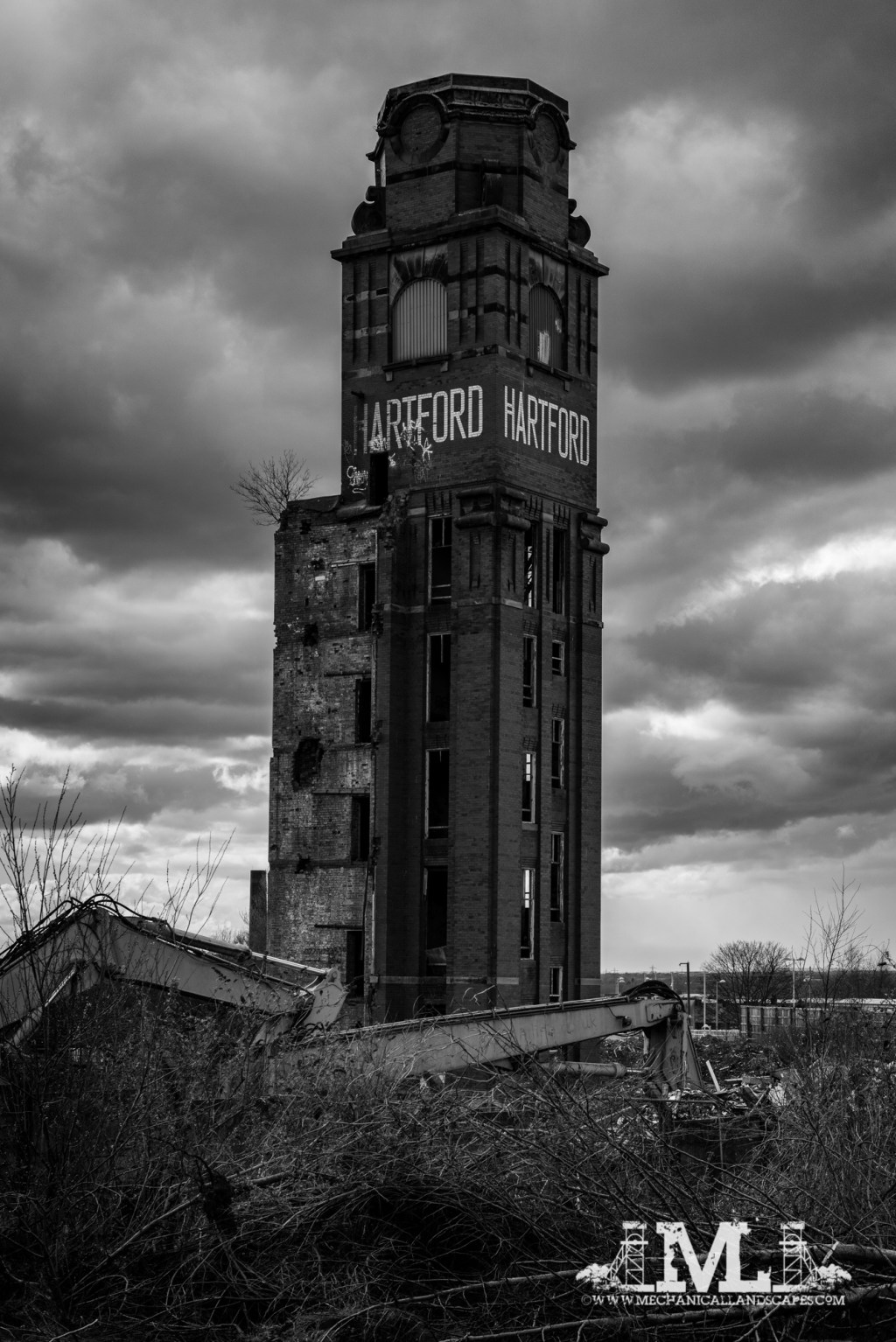
I thought that Hartford Mill had been erased from the landscape in the weeks after my visit in February 2020, turns out it hadn’t. A contact of mine who lives about 5 minutes away from it had posted a picture similar to the above on Flickr later on in 2020, but I assumed that demolition…
-
#594 – A Refreshed Typology
So with the photograph of one of the Snibston headstocks available for inclusion, I took the opportunity to refresh the typology and add in Grove Rake and Magpie Mine that I’d not included before. Grove Rake I took back in 2016, long before this project was conceived and so isn’t optimal really, but until I…
-
#592 – Snibston Mine – Part 2
The reason I visited Snibston was to see if I could make some photographs for my ongoing typology project. As I mentioned in my previous post, I feared that as the site had closed, I would either have to jump a fence or shoot from the road. However, the site reopened in 2020, thus eliminating…
-
#591 – Snibston Mine – Part 1
My only previous visit to Snibston was in 2010 (here and here), I can’t recall the occasion but it was a rather nice setup, with the site of the colliery being nicely preserved with a modern museum and short heritage railway line featuring diesel and steam shunters hauling the ubiquitous BR Mk1 coach. It was…
-
#590 – New Zine published and on sale now!
Wrecked on the beach is my first zine, and is based on my ongoing wrecks project. OK, so ‘wrecks’ is a bit of a leap of the imagination, it’s more beached and derelict ships that I’ve photographed across the UK and abroad, but hey, let’s not split hairs eh? It’s 32 pages with a colour…
-

#589 – Brierfield Mill revisited – Etchings
I was revisiting my photographs that I took at Brierfield Mill in 2016 for a potential image sale, and I came across these that I took. I’d ‘starred’ them in my Lightroom catalog but had never processed them so, five years on, I thought it was about time. I’m told that although they were removed…
-
#588 – India Mill Chimney, Darwen
My recent photos of the hilly landscape of Rotherham, and Jack Delano’s photograph of the Pittsburgh steps brought to mind the town of Darwen, a short drive from the Lancastrian flatlands of Chorley where I live. Like many northern towns, Darwen is in a valley, with some brutally steep streets heading up to the moors…
-
#587 – Steeltown Landscapes 2
Unlike the sprawling, overwhelmingly oppressive landscape of the steelworks at Scunthorpe with its acres of cooling towers, blast furnaces, coke ovens, conveyers and other artefacts of industry, the visual landscape of the Aldwarke steelworks in Rotherham is more generically industrial. Like Scunthorpe, it’s not easy to photograph from directly outside, you have to go on…
-
#586 – Steeltown Landscapes 1
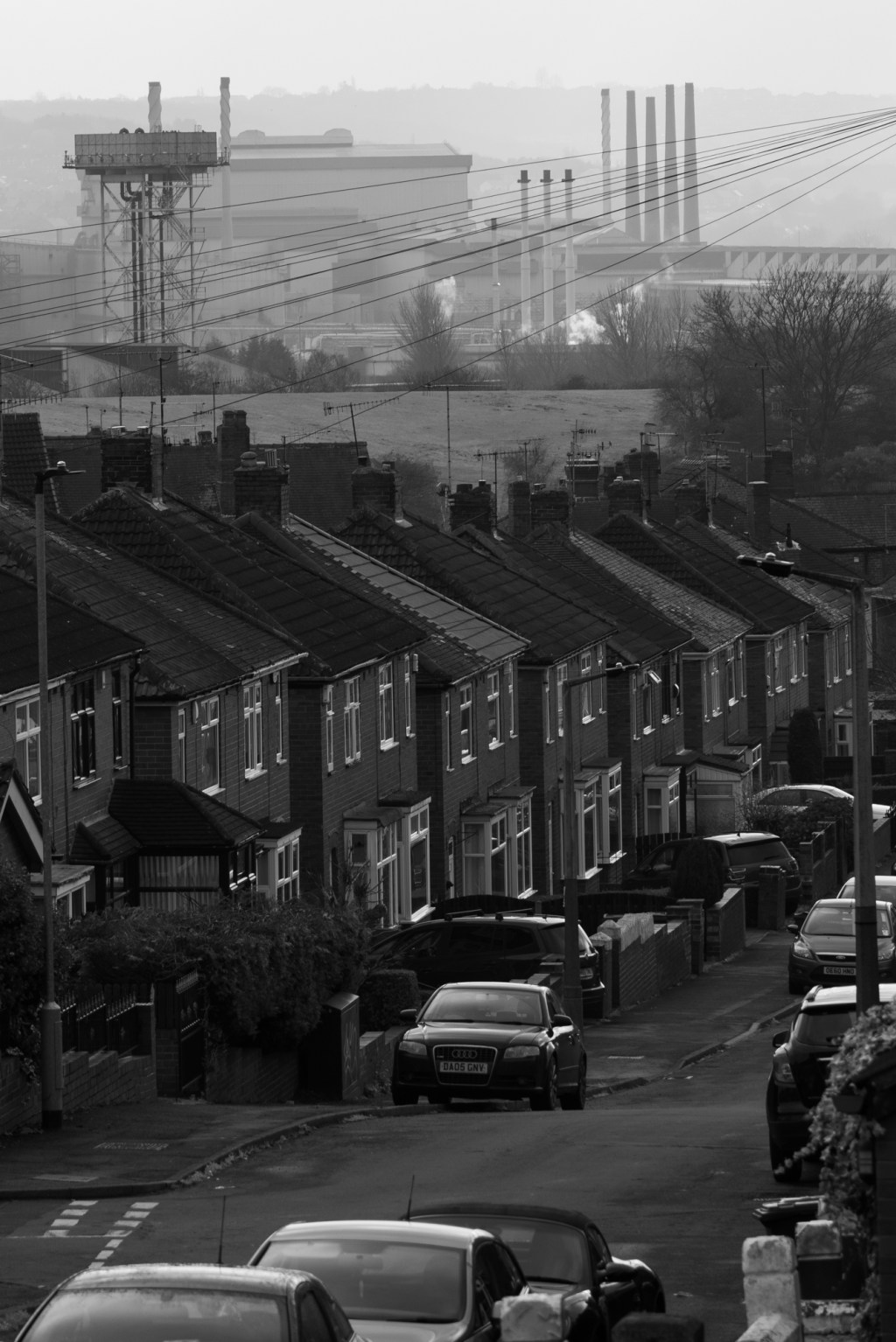
I posted a few photos a while back of Rotherham, a South Yorkshire steel town and neighbour to its more celebrated neighbour Sheffield. Britain once had many steel towns but there are relatively few now. The steel industry in Britain was once enormous and employed hundreds of thousands of people, and the economies of many…
-
#585 – Industrial Tourism – Scunthorpe 6
Since my last visit, two major buildings had come down – the Heavy Section Mill (which was disused when I visited in 2008) and the Plate Mill (which was in use until 2015 and demolished not long after). The site of the Plate Mill is now empty or used as hard standing for container storage.…

